
The capital logic behind US insurers’ growing securitized allocations

US insurer allocations to securitized assets are expanding, and regulatory capital rules are a meaningful driver. Put simply: Under the National Association of Insurance Commissioners (NAIC) risk‑based capital (RBC) framework, the higher the NAIC designation, the less capital an insurer must hold against an investment. Senior tranches across many securitized structures—CLOs, ABS, agency MBS and CMBS—often earn high NAIC designations because they are engineered to limit expected losses during stressed scenarios. As a result, they can carry relatively low NAIC capital charges—allowing insurers to earn more spread per unit of required capital than many similarly rated corporate bonds. Reflecting this dynamic, purchases of securitized bonds increased 63% from year‑end 2023 to year‑end 2025.1
Why regulators grant favorable capital treatment
The NAIC’s RBC framework is ratings‑based, with capital factors calibrated to historical credit loss experience by rating category. The design of senior securitized tranches supports favorable regulatory treatment by producing securities with demonstrably low expected losses through stressed scenarios, reflected in high NAIC designations. Three structural features are foundational.
Subordination. Securitized deals are issued in layers (sometimes called the “capital stack”). Subordination distributes credit risk across multiple, deliberately structured layers of the capital stack, creating investable opportunities beyond the most senior tranche, while preserving strong protection against expected losses. In CLOs, AAA tranches typically sit above roughly 35% subordination. In conduit CMBS, senior AAA bonds are supported by property‑level cash‑flow coverage, loan‑to‑value‑based credit enhancement, and structural subordination that often exceeds 30%. In consumer ABS senior notes are often protected by excess spread, reserve accounts, and subordinate tranches specifically designed to absorb first losses.
Performance-triggered structural deleveraging. Securitized transactions embed automatic mechanisms that respond to collateral deterioration without investor intervention. In CLOs, overcollateralization and interest-coverage tests can redirect cash flow away from junior tranches and toward senior debt when breached. CMBS structures employ similar waterfall protections, while ABS transactions rely on excess-spread trapping and reserve accounts to preserve senior credit quality.
Collateral diversification. Many securitized pools hold a large number of underlying exposures, which reduces reliance on any single borrower or property. CLO portfolios commonly hold 150–350 senior secured loans across 15–20 industries, subject to concentration limits. Consumer ABS pools contain thousands of individual obligors, materially reducing idiosyncratic default risk at the senior level. Agency MBS further benefits from explicit or implicit US government guarantees, eliminating investor exposure to mortgage credit risk at the instrument level.
Figure 1 illustrates the capital logic underpinning insurers’ growing allocation to securitized assets, with the relative value most apparent versus similar or lower-rated corporates.
Global regulatory momentum
This capital logic extends beyond the US. While other regions use different regulatory approaches, senior securitized tranches often compare well in stress‑focused capital frameworks because they are designed to limit severe losses. Japan’s transition to an ICS‑aligned regime emphasizes tail risk and market‑consistent valuation rather than expected loss, while Taiwan’s planned implementation points in a similar direction.2 Bermuda’s BSCR sits between these approaches, applying capital charges mapped to NAIC‑equivalent designations but within an economic balance‑sheet framework.3
While Japan and ICS‑aligned regimes are more model‑based than the NAIC’s factor‑driven RBC system, senior securitized tranches with substantial structural protection continue to benefit across jurisdictions from their ability to limit stress‑loss severity under adverse scenarios.
Figure 1: NAIC capital charges for life insurers
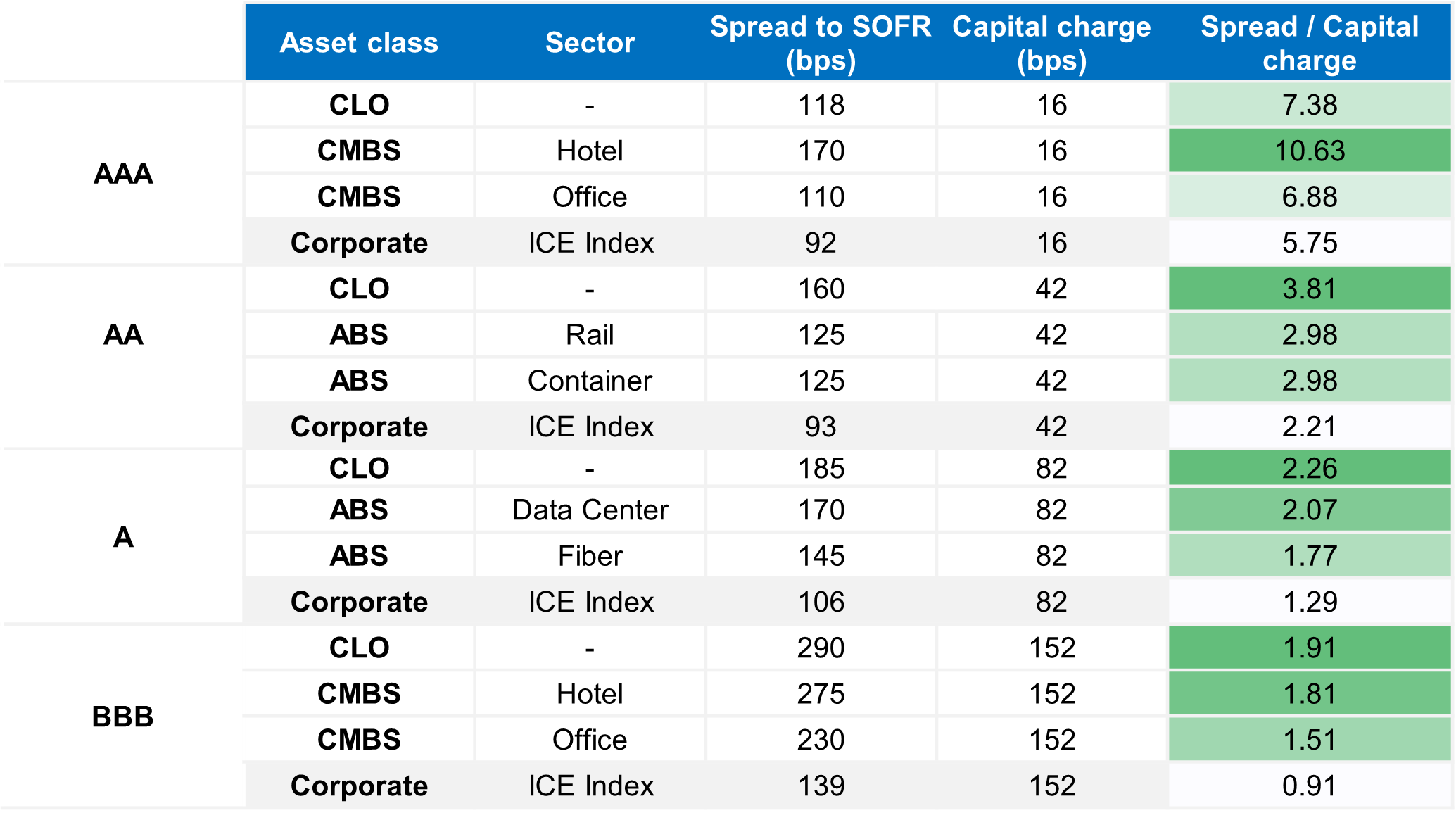
Source: Bloomberg. ICE BofA Corporate and BofA CLO data as of April 24, 2026. ABS data as of April 23, 2026. Barclays CMBS data as of April 16, 2026.
1. Based on J.P. Morgan and S&P data.
2. ICS stands for Insurance Capital Standard.
3. BSCR stands for Bermuda Solvency Capital Requirement.
Disclosures
Unless otherwise stated, references herein to "LGIM", "we" and "us" are meant to capture the global conglomerate that includes Legal & General Investment Management Ltd. (a U.K. FCA authorized adviser), Legal & General Investment Management America, Inc. (a U.S. SEC registered investment adviser) and Legal & General Investment Management Asia Limited (a Hong Kong SFC registered adviser). The LGIM Stewardship Team acts on behalf of all such locally authorized entities.
This material is intended to provide only general educational information and market commentary. Views and opinions expressed herein are as of the date set forth above and may change based on market and other conditions. The material may not be reproduced or distributed. The material is for informational purposes only and is not intended as a solicitation to buy or sell any securities or other financial instrument or to provide any investment advice or service. Legal & General Investment Management America, Inc. does not guarantee the timeliness, sequence, accuracy or completeness of information included. Past performance should not be taken as an indication or guarantee of future performance and no representation, express or implied, is made regarding future performance.
Certain of the information contained herein represents or is based on forward-looking statements or information, including descriptions of anticipated market changes and expectations of future activity. Forward-looking statements and information are inherently uncertain and actual events or results may differ from those projected. Therefore, undue reliance should not be placed on such forward-looking statements and information. There is no guarantee that LGIM America's investment or risk management processes will be successful.
We have more blogs to share
Visit our blog site to explore our latest views on markets, investment strategy and long-term themes.