
Potential opportunities in gateway markets

There are a myriad of factors supporting investment in US multifamily real estate, including solid demand from younger demographics and limited potential for homeownership amid an ongoing housing shortage.1 At a national level, we believe these favorable supply-demand dynamics bode well for ongoing attractive rent growth for institutional quality multifamily investments. However, multifamily performance prospects differ across US metro markets, with the most compelling opportunities in multifamily increasingly market specific, in our view. Against this backdrop, we see particular reasons to like select gateway markets.
The big picture
Overall, US multifamily real estate fundamentals are beginning to improve after a period of uneven performance. Although asset values have been broadly flat, we find that the national picture masks meaningful differences across markets. A dynamic supply cycle has weighed on several high-growth Sun Belt metros, while markets with more limited supply have generally held up better. With the 2024 peak in new inventory now being processed by the market, steady demand and stronger absorption are helping vacancy trend lower.
As some secondary markets continue to work through new supply, select gateway markets are benefiting from a different set of tailwinds—most notably renewed demand in the San Francisco Bay Area and a constrained construction pipeline in Chicago. These shifting dynamics may create attractive entry points where improving fundamentals are not yet fully reflected in investor sentiment.
Renewed demand
Bay Area multifamily fundamentals are closely tied to the fortunes of Silicon Valley. Its noteworthy concentration of high-tech employment left the region’s economy heavily exposed to remote work trends adopted during the COVID-19 pandemic, contributing to population decreases in the San Francisco and San Jose metro areas by 5% and 1.1% since 2020, respectively.
However, the region’s central position in the AI boom is reversing much of these losses. According to CBRE’s 2026 Tech Talent report, the San Francisco Bay Area has the nation’s highest share of AI tech talent—representing a base of nearly 100,000 highly-skilled, often younger workers. This has led to considerable demand pressure on the region’s multifamily market. San Jose, San Francisco, and the East Bay Area all number within the top 20 metropolitan areas by projected annual rent growth in 2026 for 3-Star Multifamily properties, in a list of nearly 400 markets measured by CoStar nationwide.
Constrained supply
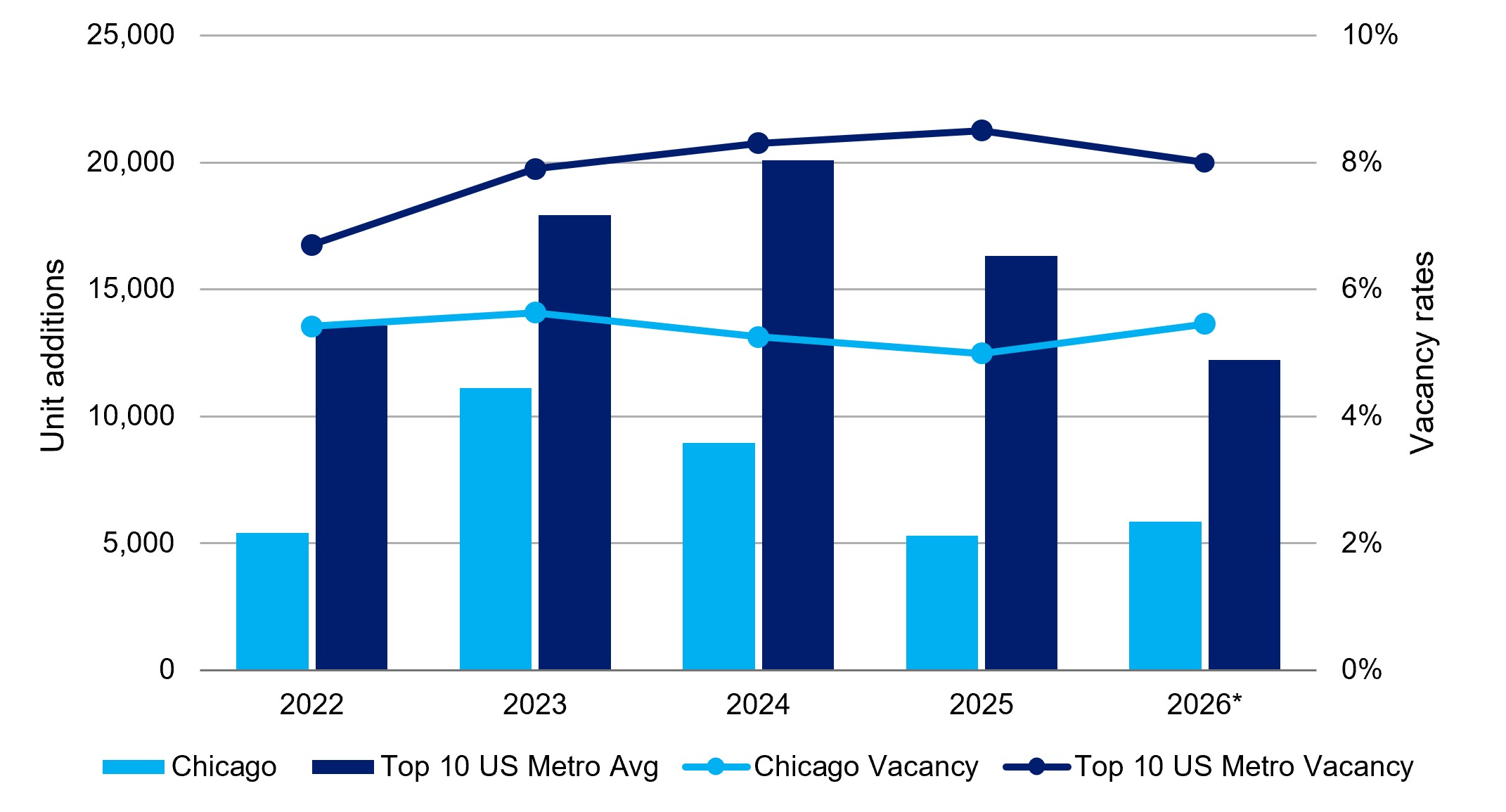
While San Francisco has benefited from a demand revival, other gateway markets are drawing investor notice due to comparatively constrained supply. While a perception of lukewarm demographics had previously kept investors away from Chicago, the effects of a comparatively narrow construction pipeline on the Windy City’s apartment fundamentals are increasingly evident. With an average of just over 7,600 units brought to market annually during the five-year period ending in 2026, Chicago experienced the slowest delivery schedule among the country’s top 10 most populous metros. This is unlikely to significantly increase in the near-to-mid-term, as the projected construction start total for the 12-month span ending in December totals just under 6,000 units, still well below the average seen in peer markets. This suggests significant upward pressure on the metro’s overall 5.5% vacancy figure is unlikely, with mid- and lower-tier housing likely to remain tight for the foreseeable future.
Additionally, Chicago’s economy is relatively insulated from both climate risks and sector-specific economic shocks, ranking “Very Low” on Green Street’s Climate Risk Index, and, more notably, ranking as the second most diverse economy nationwide among 400 metros measured by Chmura Analytics. This relative stability twinned with tepid construction growth should make Chicago a top choice for multifamily capital allocation moving forward.
Figure 1: Chicago well under peer markets in unit additions, vacancy
Source: CoStar. Data as of October 7, 2026. *Based on year-end forecast.
A local lens
The Bay Area’s demand revival and Chicago’s constrained supply illustrate why the multifamily opportunity is best understood through a local lens. Capturing that potential requires assessing the drivers of local vacancy rates and historical returns—from job growth and demographic inflows to homeownership costs and construction constraints—alongside climate risks, insurance costs and acquisition and disposition timing. With careful market selection and ongoing monitoring of local conditions, we believe US multifamily properties in attractive metros continue to offer compelling investment potential.
-
Source: L&G – Asset Management, America, “The case for US multifamily commercial real estate,” May 2026.
Disclosures
Unless otherwise stated, references herein to "L&G" and “L&G – Asset Management” refer to the global asset management business of Legal & General Group plc. that includes Legal & General Investment Management Ltd. (a U.K. FCA authorized adviser), Legal & General Investment Management America, Inc. (a U.S. SEC registered investment adviser) Legal & General Investment Management Asia Limited (a Hong Kong SFC registered adviser), Legal & General Investment Management Japan KK (licensed by the FAS in Japan), and LGIM Singapore Pte. Ltd. (licensed by the MAS in Singapore). The LGIM Stewardship Team acts on behalf of all such locally authorized entities.
This material is intended to provide only general educational information and market commentary. Views and opinions expressed herein are as of the date set forth above and may change based on market and other conditions. The material may not be reproduced or distributed. The material is for informational purposes only and is not intended as a solicitation to buy or sell any securities or other financial instrument or to provide any investment advice or service. L&G – Asset Management, America does not guarantee the timeliness, sequence, accuracy or completeness of information included. Past performance should not be taken as an indication or guarantee of future performance and no representation, express or implied, is made regarding future performance.
Certain of the information contained herein represents or is based on forward-looking statements or information, including descriptions of anticipated market changes and expectations of future activity. Forward-looking statements and information are inherently uncertain and actual events or results may differ from those projected. Therefore, undue reliance should not be placed on such forward-looking statements and information. There is no guarantee that L&G – Asset Management, America’s investment or risk management processes will be successful.
We have more blogs to share
Visit our blog site to explore our latest views on markets, investment strategy and long-term themes.