
IG private credit: A public-market complement

Improved pension funding is changing how many defined-benefit plans invest. As plans move from closing deficits toward protecting surpluses, their priorities increasingly resemble those of insurers: generating contractual income, aligning assets with liabilities and diversifying fixed-income exposure without taking uncompensated credit risk.
We believe investment-grade (IG) private credit can fit naturally into that transition, offering predominantly fixed-rate assets across the maturity spectrum, alongside issuers and financing structures not commonly available in public bond markets.
A clearer view of private credit
The label “private credit” brings together two growing markets. The IG and sub-IG private credit markets combined broadly exceeded $4.5 trillion by the second half of 2026, with IG private credit alone, historically associated with the private placement market, representing approximately $2.4 trillion.1 While insurance demand is still the primary driver, the IG market is attracting greater interest from pension plans—and supply is responding to that expanding investor base. Annual issuance exceeded $200 billion in 2025, up from approximately $100 billion annually historically, and activity through the first half of 2026 is already running ahead of the comparable 2025 period.2
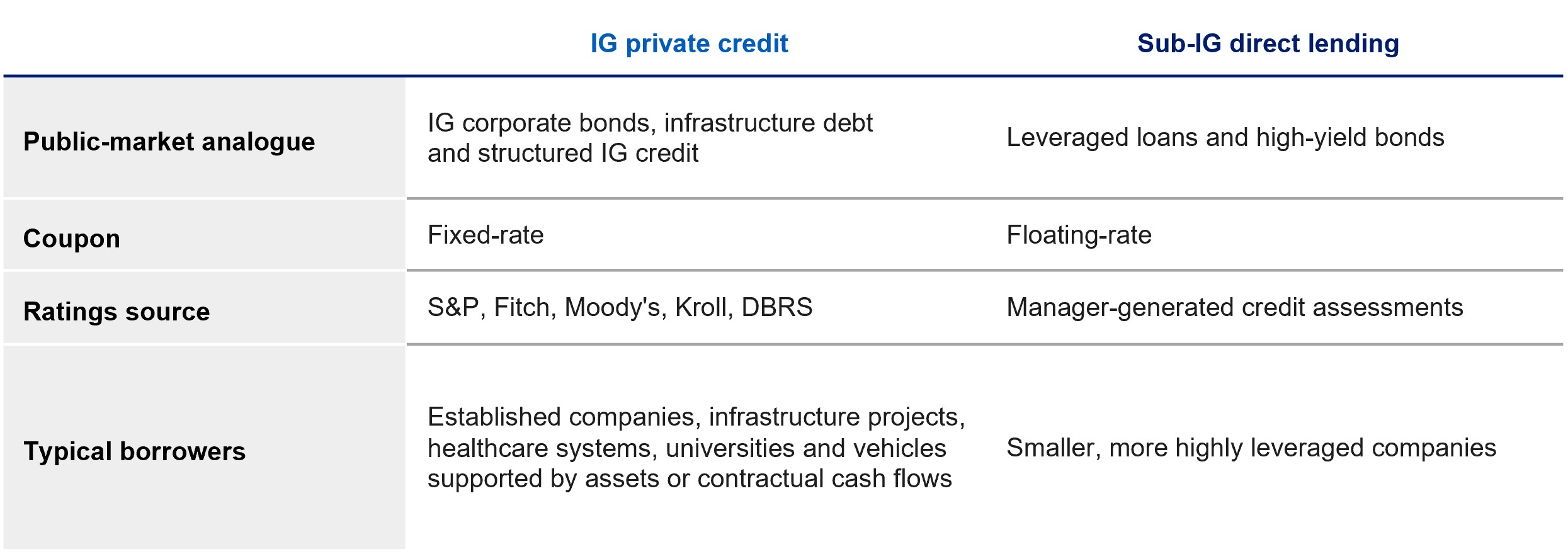
While IG and sub-IG private credit markets share a private origination channel, they otherwise have meaningfully different characteristics. We view IG private credit as extending the characteristics of public IG fixed income into privately negotiated markets, while sub-IG direct lending essentially extends the allocation of leveraged finance into privately negotiated markets. Figure 1 summarizes key the key differences.
Figure 1: Key differences between IG and sub-IG private credit
Source: L&G – Asset Management, America. For illustrative purposes only. The attributes described above reflect general characteristics commonly associated with private credit investments and are not intended to represent the characteristics of every investment. Actual investments may differ significantly with respect to credit quality, structure, duration, liquidity, collateral, risk, and return potential. Characteristics are subject to change and should not be viewed as indicative of future investment outcomes.
Given each market’s typical borrowers, IG private credit and sub-IG direct lending can provide investors with different sector exposures. Direct-lending portfolios often finance sponsor-owned software and business-services companies. The IG private credit market is more heavily oriented toward infrastructure, utilities, industrials, financial services, consumer businesses and specialized asset-based finance. Technology-related exposures, meanwhile, are classified according to the financed assets or cash flow, and commonly are part of the IG market through data centers, fiber networks, energy infrastructure or equipment financing.
An extension of public IG credit allocations
For pension investors, IG private credit can extend an existing public fixed-income allocation into privately negotiated assets without requiring a move materially down the credit spectrum. Both public and private IG exposures can offer IG credit quality, contractual income and long-duration cash flows. However, private exposures can provide access to issuers, assets and structures that often sit outside public bond indexes. We see the potential value of adding IG private exposures coming from three sources.
- Incremental income. IG private credit potentially provides additional spread and contractual income relative to comparable public bonds, reflecting reduced liquidity, bespoke structuring, non-standard maturities and less familiar issuers. BofA data suggests the average spread premium of IG private over public counterparts is roughly 67 basis points (bps), with the high a premium of 190 (bps).3
- Stronger lender protections. IG private credit often comes with negotiated covenants, enhanced reporting, prepayment provisions and, where appropriate, security or restrictions on additional debt, asset sales and distributions.
- Expanded issuer access. IG private credit can offer exposure to private companies, infrastructure assets, healthcare and educational institutions, project-finance vehicles and contractual cash flows that are limited or absent in public credit indexes.
A broader IG issuer universe
While digital infrastructure represents the fastest-growing source of private IG issuance today, it is only one component of IG private credit’s much broader opportunity set. The IG private credit market spans institutions, infrastructure assets, private enterprises and contractual cash-flow structures, creating an issuer universe that is often wider and more diverse than public corporate bond markets alone. Borrowers generally enter the market seeking customized financing, long-term capital, confidentiality or the ability to finance assets and cash flows that do not fit neatly within traditional public bond structures. These borrowers span five key categories.
- Mission-critical institutions. Some of the largest borrowers in the market are neither corporations nor governments. They are:
- Universities building student housing, athletic facilities or research space
- Healthcare systems financing new campuses, outpatient networks or specialized treatment centers
- Research institutions expanding their laboratory capacity or scientific infrastructure
- Growth & transformation capital. Digital infrastructure has emerged as one of the most visible sources of issuance. These borrowers include:
- Data center developers constructing new hyperscaler capacity
- Fiber-network operators expanding connectivity between major metropolitan areas
- Electric utilities investing in transmission and grid upgrades to support rising power demand
- Power-generation assets financing new capacity to support cloud computing and AI growth
- Asset-Based & contractual cash flows. Other issuance is characterized more by identifiable assets or contractual payment streams. These include:
- Equipment owners financing a fleet of transportation or industrial assets
- Fund sponsors financing against committed but uncalled investor capital
- Businesses monetizing long-term royalty streams
- Long-lived essential assets. Many infrastructure assets require financing measured in decades rather than years. Examples include:
- Toll roads refinancing long-term construction debt
- Airports funding terminal expansion and modernization
- Transmission utilities investing in regional electric infrastructure
- Renewable-energy projects financing wind, solar or storage assets
- Confidentiality & relationship-driven borrowers. Finally, some established and well-capitalized enterprises turn to private IG markets because they value long-term institutional capital but have little interest in becoming regular public-market issuers. They may be:
- Sports leagues or franchises financing facilities and strategic initiatives
- Family-owned businesses seeking long-term financing without public disclosure requirements
- Professional-services partnerships funding growth while maintaining private ownership
A natural fit for surplus preservation
For plans that have made meaningful progress on funded status, the question is less about adding return at any cost and more about building a credit portfolio that can support surplus preservation over time. The private IG market expands an IG credit allocation’s access to institutions, infrastructure assets, specialized financing structures and privately owned enterprises that are often unavailable in public IG markets, while offering investors the potential for incremental spread and stronger lender protections.
In that context, IG private credit can help widen the investable toolkit without changing the fundamental role of high-quality fixed income. It may offer a way to seek additional spread, negotiated protections and differentiated sources of cash flow while maintaining a focus on credit discipline.
The bottom line: As interest in the private credit market broadens beyond insurers, pension investors may find that IG private credit is not simply a niche allocation, but a practical complement to public IG exposures for portfolios increasingly focused on resilience, income visibility and long-term liability-aware outcomes.
-
Source: L&G – Asset Management, America, BofA. Data as of June 30, 2026. Sub-IG data sourced from Preqin as of December 31, 2025.
-
Source: L&G – Asset Management, America, Private Placement Monitor. Data as of June 30, 2026.
-
Source: BofA. Data as of June 30, 2026.
Disclosures
Unless otherwise stated, references herein to "L&G" and “L&G – Asset Management” refer to the global asset management business of Legal & General Group plc. that includes Legal & General Investment Management Ltd. (a U.K. FCA authorized adviser), Legal & General Investment Management America, Inc. (a U.S. SEC registered investment adviser) Legal & General Investment Management Asia Limited (a Hong Kong SFC registered adviser), Legal & General Investment Management Japan KK (licensed by the FAS in Japan), and LGIM Singapore Pte. Ltd. (licensed by the MAS in Singapore). The LGIM Stewardship Team acts on behalf of all such locally authorized entities.
This material is intended to provide only general educational information and market commentary. Views and opinions expressed herein are as of the date set forth above and may change based on market and other conditions. The material may not be reproduced or distributed. The material is for informational purposes only and is not intended as a solicitation to buy or sell any securities or other financial instrument or to provide any investment advice or service. L&G – Asset Management, America does not guarantee the timeliness, sequence, accuracy or completeness of information included. Past performance should not be taken as an indication or guarantee of future performance and no representation, express or implied, is made regarding future performance.
Certain of the information contained herein represents or is based on forward-looking statements or information, including descriptions of anticipated market changes and expectations of future activity. Forward-looking statements and information are inherently uncertain and actual events or results may differ from those projected. Therefore, undue reliance should not be placed on such forward-looking statements and information. There is no guarantee that L&G – Asset Management, America’s investment or risk management processes will be successful.
We have more blogs to share
Visit our blog site to explore our latest views on markets, investment strategy and long-term themes.