
SpaceX IPO launches: Implications for index exposures
Index vendors have been reviewing and updating their inclusion rules to adapt to a changing IPO landscape, though differences remain, with implications for investors.
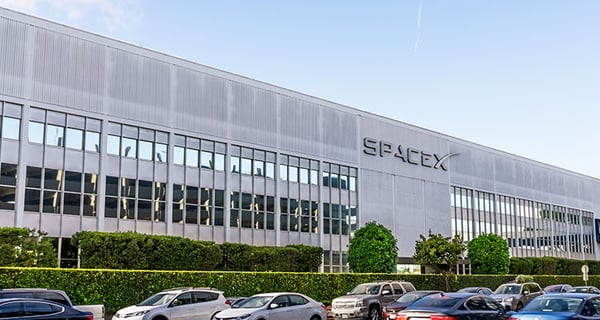
2026 is increasingly poised to become the year of the mega-cap IPO. With listings from the likes of SpaceX, Anthropic and OpenAI planned this year, index vendors are figuring out how to incorporate and fast-track these companies of such extraordinary scale into their benchmark indexes.
At a target valuation of $1.8 trillion, SpaceX’s IPO represents the largest ever, possibly soon to be followed by Anthropic and OpenAI, which are each indicating valuations approaching $1 trillion. These valuations are much larger than IPOs over recent years, reflecting how increased opportunities to grow in the private-market space have enabled companies to remain private for longer than in previous cycles. As a result, when these firms finally enter public markets, they do so at a far more mature stage—often with valuations that rival or exceed long‑standing index constituents.
In response to these exceptionally large IPOs, index providers, aiming to reflect the investible market are reevaluating their rules concerning eligibility criteria, timing of inclusion and size thresholds for mega-cap new entrants. Indeed, market participants have been asked to weigh in on multiple index consultations on these matters over the first half of the year. However, even with the inclusion rule changes, differences between index provider rules remain, with implications for investors seeking to reflect these IPOs in their portfolios in a timely manner.
As of writing, we have seen methodology updates from FTSE Russell and NASDAQ, whereas S&P ultimately made no change to its S&P 1500 Composite (which includes the S&P 500 Index). In the table below, we look across the index provider landscape to ascertain how index rules are adapting to the mega-cap IPOs.
Figure 1: Index providers are adapting rules as a result of mega-cap IPOs
| Index provider | S&P | RUSSELL US | NASDAQ 100 | MSCI [No consultation /rule changes] |
| New Large/Mega-Cap Specific Rules | No new rules for mega-cap IPOs | Yes | Yes | N/A |
| FAST Entry/Inclusion Timeline Updates [Large IPO] | No change [stock needs to trade for 12 months to be eligible] | Yes: IPO + 5 days entry for larger IPOs [from quarterly] | Yes: IPO + 15 days [from at least 3 months typically] |
Already in place: IPO + 10 days |
| Free-Float Rule Updates | No change [10% free-float threshold remains] | Yes: Eligible for fast entry if expectation for 5% free float within 12 months post IPO | Yes: Weight capped at 3x free float when float below 33.33% | N/A |
| Index Specific Eligibility Rules | Financial viability rule remains | Yes: Eligible for fast entry when 5% voting threshold expected to be met within 12 months | N/A | N/A |
Source: L&G – Asset Management, America, S&P, FTSE Russell, Nasdaq, MSCI. Data as of June 9, 2026.
It’s worth highlighting that these mega-cap IPOs may not make up as much of the index as some may expect. While a company like SpaceX with a full market-cap valuation of nearly $1.8 trillion would place it in the top 10 of companies in the Russell 1000 by full market capitalization, companies are added to these indexes based on free-float rules. We expect that the SpaceX free float will initially be approximately 4%, representing a much smaller index weight than companies of similar sizes.
Figure 2: SpaceX index weight likely to be lower than similar size companies
SpaceX - Size and illustrative Russell 1000 index weight
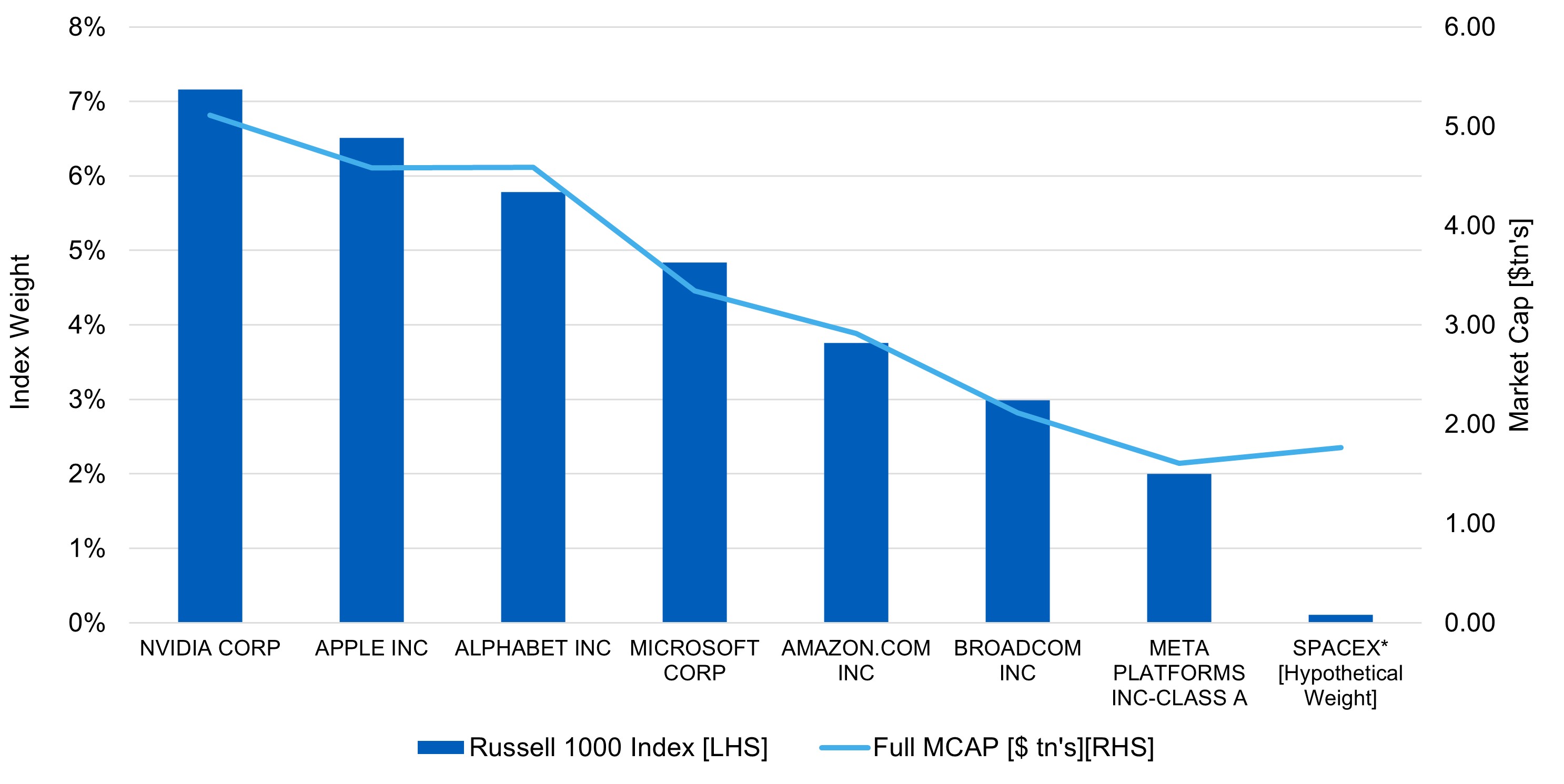 Source: FTSE Russell, Bloomberg, L&G – Asset Management, America. Data as of May 29, 2026. Hypothetical Russell 1000 index weight of SpaceX valued at $75 billion. For illustrative purposes only.
At a $75 billion IPO amount, SpaceX will be more than twice the size of the previous largest IPO – Saudi Aramco in 2019, which raised $29 billion. These sizes reflect the underlying structural shift where companies can come to the market later in the investment cycle.
Figure 3: SpaceX IPO size: A comparison
Selected mega-cap IPOs - Offer size [$Bn]
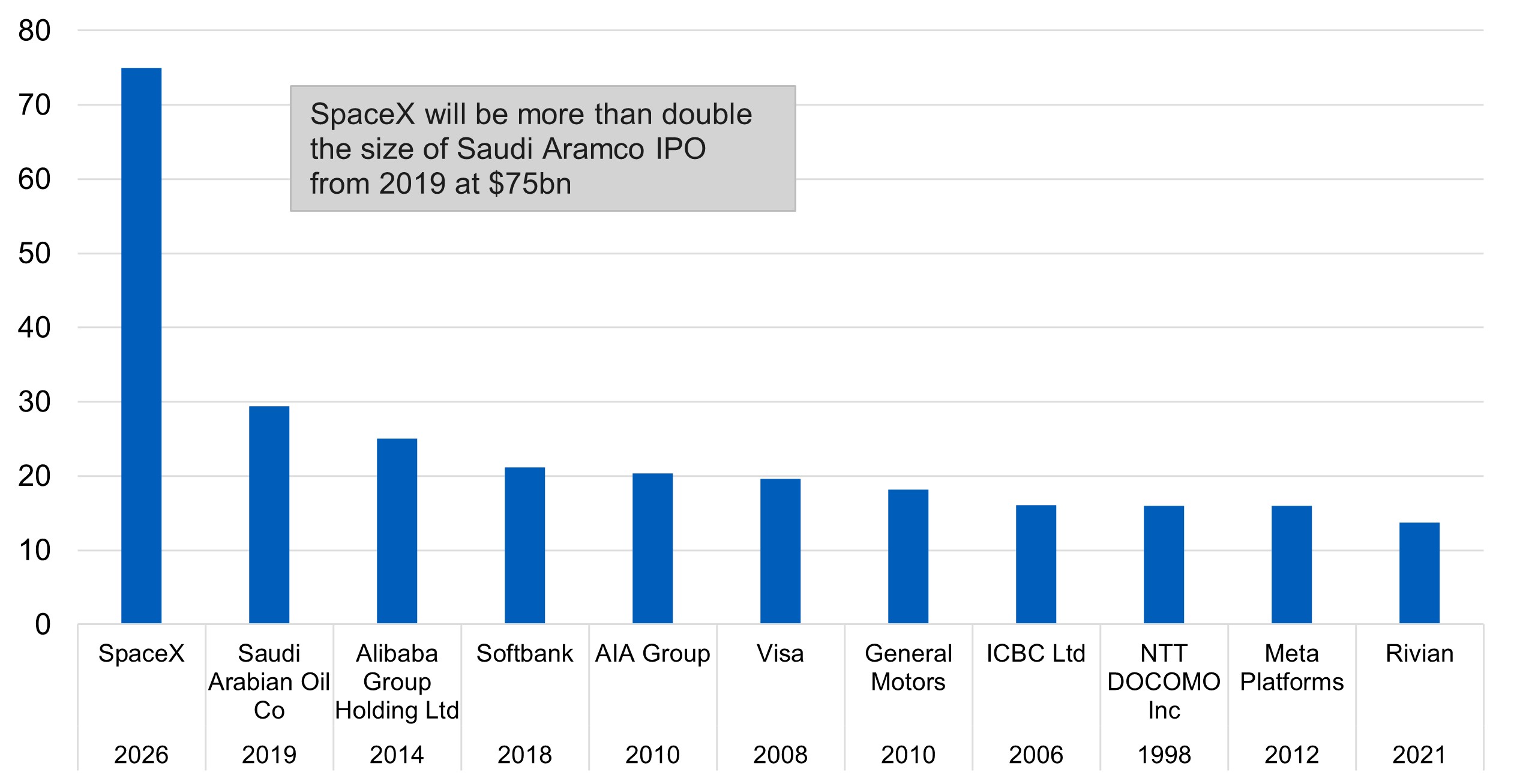 Source: Bloomberg, L&G – Asset Management, America. Data as of June 9, 2026.
The investing implications
Although some index providers are moving to accelerate inclusion timelines for mega-cap IPOs, SpaceX would still likely need to wait at least 12 months before qualifying for S&P 500 index inclusion. Ahead of SpaceX’s inclusion in a given index, investment managers must carefully consider the trade-off between incurring tracking error and capturing potential upside by holding the stock ahead of its benchmark entry. Typically index fund managers are price takers having to allocate capital to these IPOs at a given index’s inclusion point.
Index-plus or enhanced-beta strategies can play an important role in this environment. These approaches aim to deliver returns above the benchmark by introducing a controlled level of active risk while retaining the cost advantages of passive investing. Allocating to IPOs can be an effective way for these strategies to generate incremental alpha, enabling managers to participate in early performance drivers without significantly deviating from benchmark characteristics.
Figure 4: Mega-cap eligibility into indexes varies
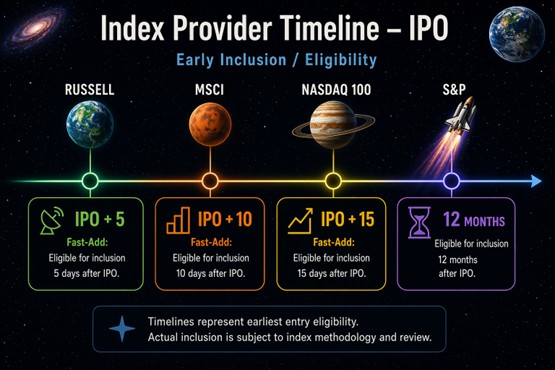 Source: L&G – Asset Management, America estimates based on available information, artificial intelligence. For Russell, MSCI and NASDAQ timelines reflect fast-entry for defined large-cap IPOs in Russell US, MSCI GIMI and Nasdaq 100 series. Data as of June 9, 2026.
Disclosures
Unless otherwise stated, references herein to "L&G" and “L&G – Asset Management” refer to the global asset management business of Legal & General Group plc. that includes Legal & General Investment Management Ltd. (a U.K. FCA authorized adviser), Legal & General Investment Management America, Inc. (a U.S. SEC registered investment adviser) Legal & General Investment Management Asia Limited (a Hong Kong SFC registered adviser), Legal & General Investment Management Japan KK (licensed by the FAS in Japan), and LGIM Singapore Pte. Ltd. (licensed by the MAS in Singapore). The LGIM Stewardship Team acts on behalf of all such locally authorized entities.
This material is intended to provide only general educational information and market commentary. Views and opinions expressed herein are as of the date set forth above and may change based on market and other conditions. The material may not be reproduced or distributed. The material is for informational purposes only and is not intended as a solicitation to buy or sell any securities or other financial instrument or to provide any investment advice or service. L&G – Asset Management, America does not guarantee the timeliness, sequence, accuracy or completeness of information included. Past performance should not be taken as an indication or guarantee of future performance and no representation, express or implied, is made regarding future performance.
Certain of the information contained herein represents or is based on forward-looking statements or information, including descriptions of anticipated market changes and expectations of future activity. Forward-looking statements and information are inherently uncertain and actual events or results may differ from those projected. Therefore, undue reliance should not be placed on such forward-looking statements and information. There is no guarantee that L&G – Asset Management, America’s investment or risk management processes will be successful.
We have more blogs to share
Visit our blog site to explore our latest views on markets, investment strategy and long-term themes.