
Looking beyond the label: Unpacking the US Agg’s securitized allocation

For many public pension plans, the Bloomberg US Aggregate Bond Index (the “Agg”) serves as the default reference point for core fixed income. Investors are often aware of the Agg’s nearly 50% allocation to US Treasuries. Less obvious is that while the benchmark is broad by design, its securitized allocation may be narrower—and more concentrated—than the label suggests, excluding a meaningful portion of the investable universe. For public plans seeking income and diversification from core fixed income, that distinction matters.
The Agg’s securitized exposure is narrower than it appears
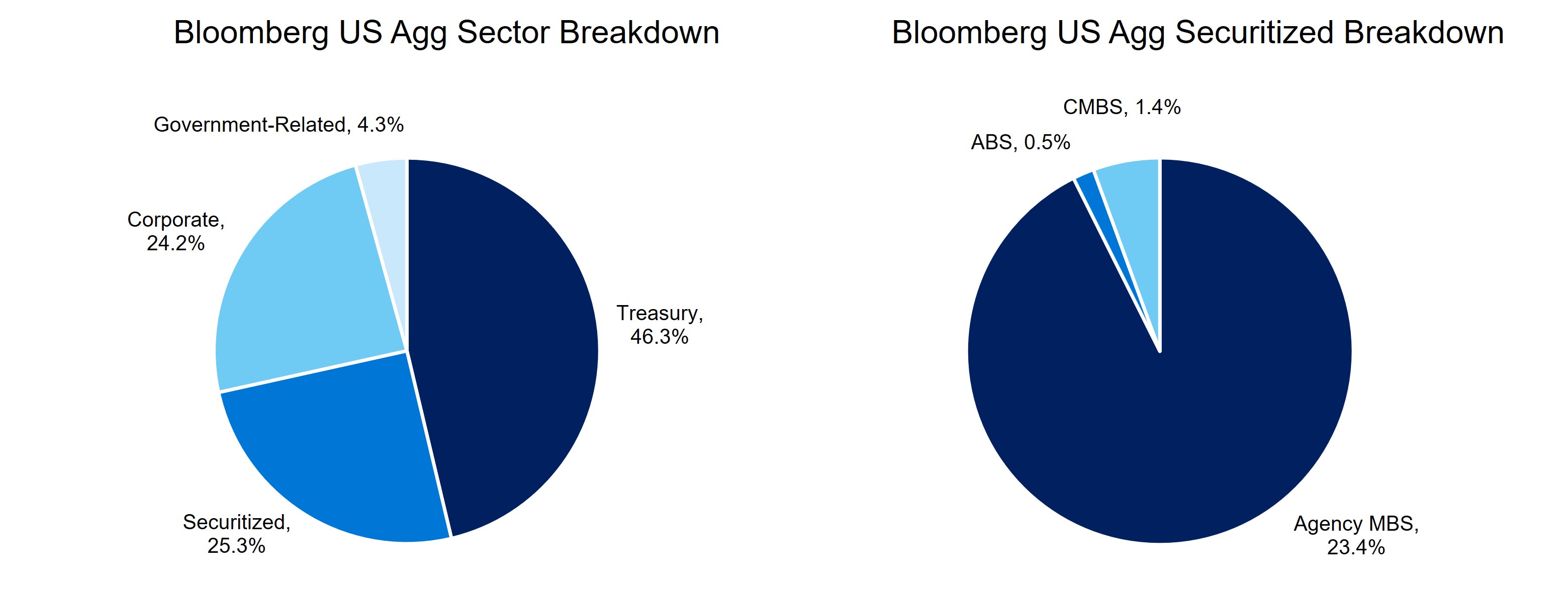
Securitized assets represent about a quarter of the Agg by market value.1 At first glance, that appears to provide a meaningful allocation to a diverse asset class. A closer look, however, reveals that roughly 23% of the index is composed of fixed-rate agency mortgage-backed securities (MBS), while only about 2% is allocated to asset-backed securities (ABS) and commercial mortgage-backed securities (CMBS). In other words, over 90% of the Agg’s securitized allocation is concentrated within agency MBS, providing far less sector diversification than many investors might think.
Figure 1: Over 90% of the Agg’s securitized allocation is concentrated in agency MBS
Source: Bloomberg. Data as of August 31, 2026.
This composition is a byproduct of the index’s inclusion and weighting criteria. The Agg is weighted by market value, so its sector allocations are driven by the amount of eligible debt outstanding rather than by an assessment of the most attractive risk-adjusted return opportunities. The agency mortgage market is large, primarily fixed rate, and closely aligned with the index’s credit-quality and minimum-size requirements, allowing it to fit naturally within the index’s framework. But this favorability for index construction ultimately leads to underrepresentation of key parts of the broader securitized market.
As a result, ABS and CMBS face a challenging path into the benchmark. Eligible securities must satisfy minimum deal and tranche sizes, maintain at least one year of remaining average life, and meet investment-grade, fixed-rate, issuance and pricing requirements. Those screens leave out meaningful parts of the broader securitized universe, including floating-rate securities, collateralized loan obligations (CLOs), and many specialty ABS sectors. As a result, the Agg reflects the portion of the securitized market that adheres to its rules, not necessarily the full opportunity set available to investors.
This is an important distinction because agency MBS behaves differently from traditional corporate credit and other securitized sectors. Unlike most spread sectors in the Agg, agency MBS investors generally do not bear the direct credit risk of the underlying mortgage borrowers. Timely payment of principal and interest is explicitly or implicitly guaranteed by US government entities. However, the underlying loans are generally prepayable at par, effectively giving homeowners a call option. As a result, MBS valuations are highly sensitive to the pace of prepayments and the factors that influence homeowner activity, including interest-rate levels, interest-rate volatility and general US housing market activity.
These inherent risks are widely telegraphed and can be mitigated by experienced investment managers, but in this scenario, the primary concern is concentration. When agency MBS is combined with the Agg’s sizable Treasury allocation, nearly 70% of benchmark exposure is driven by interest-rate risk, leaving only a small portion of the benchmark exposed to credit spread-based income. That much concentration in lower-spread investments may not provide the adequate return profile that public plans expect from their core fixed income allocation, particularly when long-term return objectives place a premium on durable income.
Diversifying beyond agency MBS can broaden sources of income and spread
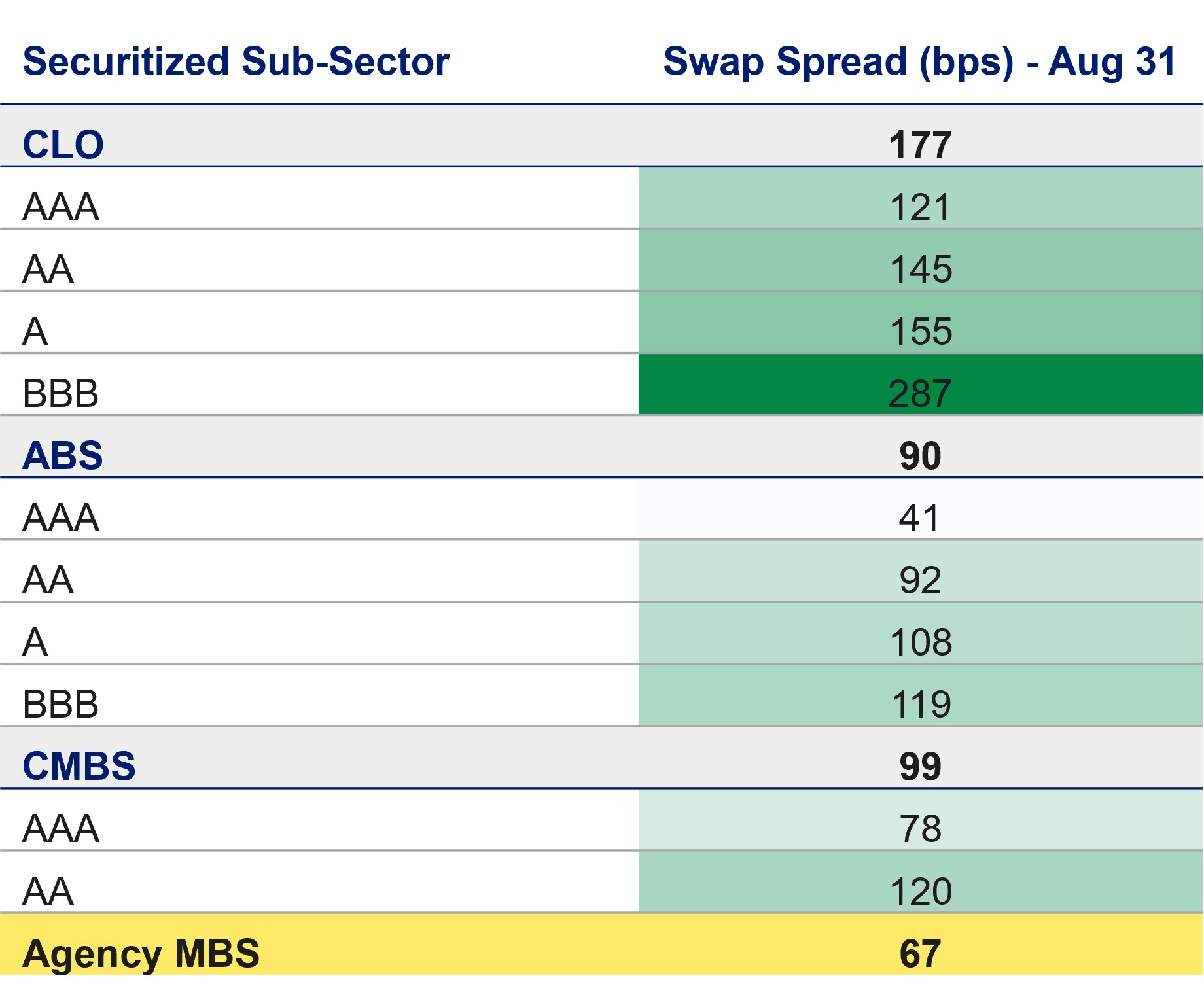
For investors willing to look beyond the benchmark, securitized credit can offer a broader and more intentional opportunity set. A dedicated securitized allocation allows investors to approach the asset class more intentionally. Rather than accepting issuance-driven weights, investors can diversify across agency MBS, non-agency MBS, ABS, CMBS and CLOs, which offer exposure to diversified collateral pools, structures and sources of repayment.
Senior securitized bonds may also benefit from structural protections such as subordination, overcollateralization, performance triggers and excess spread. Their complexity requires careful and proven underwriting capabilities, but that complexity can potentially offer material compensation that is not available in more standardized parts of the bond market.
Figure 2: A dedicated diversified securitized allocation may offer additional spread potential
Source: JP Morgan, Bank of America, Barclays. Data as of August 27, 2026.
From benchmark exposure to intentional allocation
The key takeaway is not that investors should abandon the Agg or agency MBS. Both can play important roles in a fixed income portfolio. Rather, public plans should look under the hood to assess whether their benchmark-driven securitized exposure provides the balance of income, diversification and risk exposure their fixed income allocation is intended to deliver. For plans seeking more durable income and a broader opportunity set, moving beyond benchmark exposure may be an important step toward a more intentional fixed income allocation.
We have more blogs to share
Visit our blog site to explore our latest views on markets, investment strategy and long-term themes.
-
Source: Bloomberg. Data as of August 31, 2026.
Disclosures
Unless otherwise stated, references herein to "L&G" and “L&G – Asset Management” refer to the global asset management business of Legal & General Group plc. that includes Legal & General Investment Management Ltd. (a U.K. FCA authorized adviser), Legal & General Investment Management America, Inc. (a U.S. SEC registered investment adviser) Legal & General Investment Management Asia Limited (a Hong Kong SFC registered adviser), Legal & General Investment Management Japan KK (licensed by the FAS in Japan), and LGIM Singapore Pte. Ltd. (licensed by the MAS in Singapore). The LGIM Stewardship Team acts on behalf of all such locally authorized entities.
This material is intended to provide only general educational information and market commentary. Views and opinions expressed herein are as of the date set forth above and may change based on market and other conditions. The material may not be reproduced or distributed. The material is for informational purposes only and is not intended as a solicitation to buy or sell any securities or other financial instrument or to provide any investment advice or service. L&G – Asset Management, America does not guarantee the timeliness, sequence, accuracy or completeness of information included. Past performance should not be taken as an indication or guarantee of future performance and no representation, express or implied, is made regarding future performance.
Certain of the information contained herein represents or is based on forward-looking statements or information, including descriptions of anticipated market changes and expectations of future activity. Forward-looking statements and information are inherently uncertain and actual events or results may differ from those projected. Therefore, undue reliance should not be placed on such forward-looking statements and information. There is no guarantee that L&G – Asset Management, America’s investment or risk management processes will be successful.