
CIO Insight: Higher long-term Treasury yields in context

Recent headlines have focused on the rise in long-term Treasury yields and policymakers’ efforts to push them lower. But framing this as a uniquely US fiscal story misses the bigger picture. The forces influencing long-term rates are global, interconnected and not entirely new.
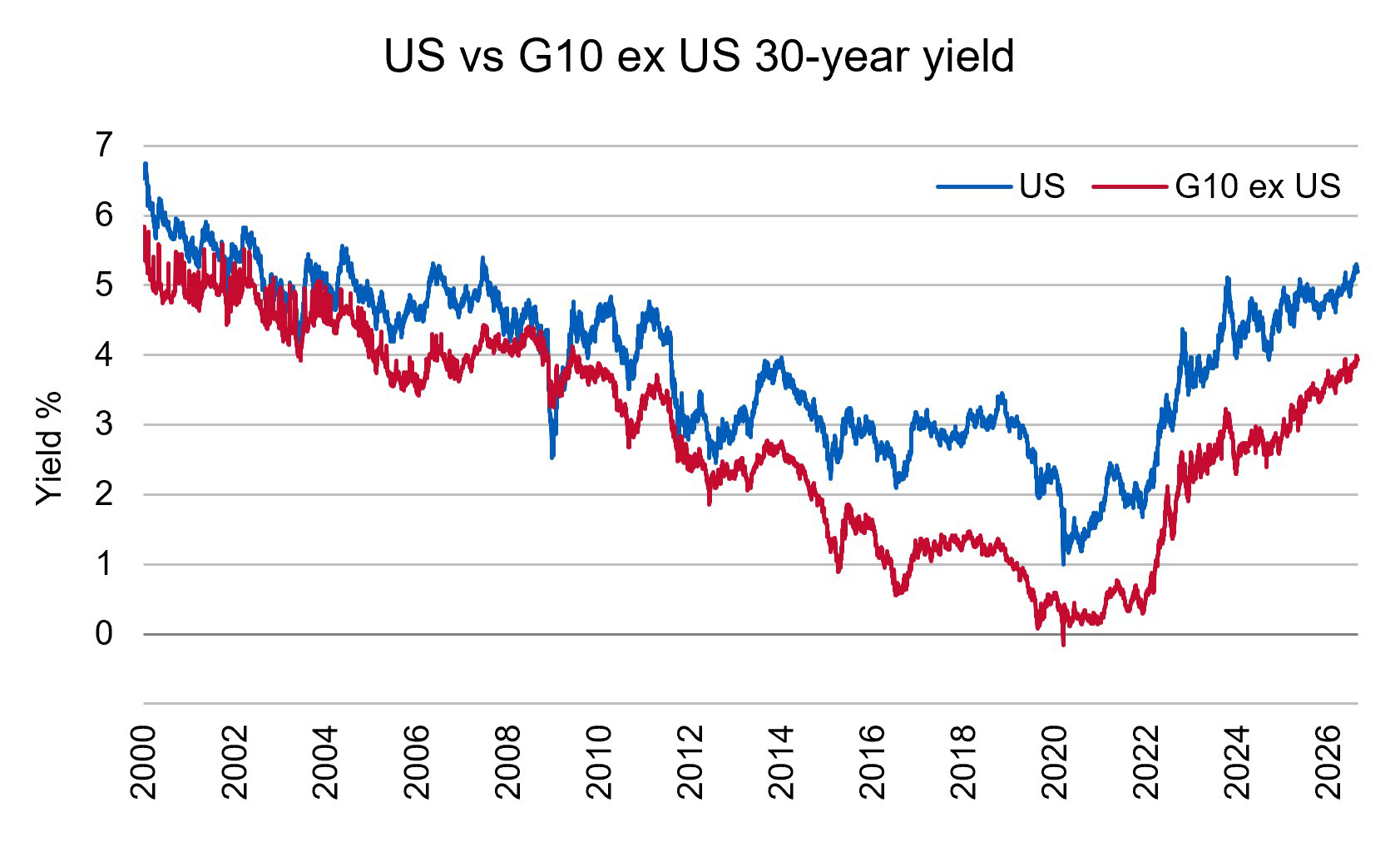
It is worth starting with some historical perspective. While today’s yields may appear high relative to the exceptionally low-rate period following the global financial crisis, they are not especially inconsistent with current levels of nominal growth and inflation. Similar combinations of economic growth and inflation have historically been associated with comparable, and sometimes higher, interest rates, including periods when government deficits attracted far less concern.
Fiscal policy nevertheless matters. Since the pandemic, governments have dramatically increased spending to support economic activity. That response was necessary at the time. The challenge is that, several years later, many governments have shown little appetite to meaningfully reduce spending or rein in deficits. Debt burdens remain elevated across much of the developed world, and investors increasingly require greater compensation to absorb the resulting supply and uncertainty.
A cross-market dynamic
This is also not simply a Treasury market phenomenon. Global rates markets are deeply connected through capital flows, relative value and currency markets. Japan is emerging from decades of persistent deflation and extraordinarily accommodative monetary policy. Europe is preparing to borrow more to fund defense and infrastructure. As Japanese and European yields rise, global investors have more alternatives to US Treasuries, placing some upward pressure on US rates as well. Efforts by the US and Japan to resist excessive yen weakness add another layer to these cross-market dynamics.
A less conventional source of pressure is also emerging from the private sector. Hyperscalers and other companies across the AI ecosystem are issuing substantial amounts of debt to finance data centers, power infrastructure and related investment. AI-related issuance has exceeded $400 billion through July 2026, with hyperscalers accounting for approximately 40% of the total.1
That creates an interesting reversal of the traditional crowding-out narrative. We usually think of heavy government borrowing as absorbing available capital and raising financing costs for companies—and that’s likely still the dominant factor. However, the scale of these financing needs underscores a broader point: Competition for long-duration capital is coming from both the public and private sectors.
A confluence of pressures
Viewed through this lens, the upward pressure on long-term yields is neither recent nor driven by a single factor. Persistent deficits matter, but so do resilient nominal growth, changing monetary regimes overseas and an unusually capital-intensive technology investment cycle.
Recent policy proposals aimed at lowering long-end yields illustrate the challenge. Governments can influence market dynamics through issuance patterns and other forms of market “plumbing.” These actions may temporarily affect supply and demand conditions. But they cannot permanently override the economic fundamentals or global capital flows that ultimately determine the price of long-term money.
What does this mean for investors?
Long-end yields may remain structurally higher than many expected a few years ago. But higher yields are not solely a headwind. They also provide income and potential protection that were largely absent during the post-crisis period.
For investors able to distinguish between sound balance sheets and borrowing driven by increasingly ambitious capital plans, we believe today’s market offers a more compelling, although more selective, opportunity across high-quality fixed income.
Figure 1: The forces influencing long-term rates are global, interconnected and not entirely new
Source: Bloomberg. Data as of August 25, 2026.
-
Source: BofA, L&G – Asset Management, America.
Disclosures
Unless otherwise stated, references herein to "L&G" and “L&G – Asset Management” refer to the global asset management business of Legal & General Group plc. that includes Legal & General Investment Management Ltd. (a U.K. FCA authorized adviser), Legal & General Investment Management America, Inc. (a U.S. SEC registered investment adviser) Legal & General Investment Management Asia Limited (a Hong Kong SFC registered adviser), Legal & General Investment Management Japan KK (licensed by the FAS in Japan), and LGIM Singapore Pte. Ltd. (licensed by the MAS in Singapore). The LGIM Stewardship Team acts on behalf of all such locally authorized entities.
This material is intended to provide only general educational information and market commentary. Views and opinions expressed herein are as of the date set forth above and may change based on market and other conditions. The material may not be reproduced or distributed. The material is for informational purposes only and is not intended as a solicitation to buy or sell any securities or other financial instrument or to provide any investment advice or service. L&G – Asset Management, America does not guarantee the timeliness, sequence, accuracy or completeness of information included. Past performance should not be taken as an indication or guarantee of future performance and no representation, express or implied, is made regarding future performance.
Certain of the information contained herein represents or is based on forward-looking statements or information, including descriptions of anticipated market changes and expectations of future activity. Forward-looking statements and information are inherently uncertain and actual events or results may differ from those projected. Therefore, undue reliance should not be placed on such forward-looking statements and information. There is no guarantee that L&G – Asset Management, America’s investment or risk management processes will be successful.
We have more blogs to share
Visit our blog site to explore our latest views on markets, investment strategy and long-term themes.