
Broadening the search for alpha in insurance credit portfolios

Public investment grade (IG) credit remains central to insurance portfolios, but insurers are broadening their search for incremental return across private and securitized markets. The challenge is not simply to find more spread. It is to identify opportunities that offer adequate compensation for credit risk, complexity and illiquidity while meeting the portfolio’s liability, liquidity and capital requirements.
Ample capital, shifting allocations
Insurers are entering the current market from a position of strength. S&P Global Ratings estimates that total available capital among the insurers it rates rose to approximately $5.0 trillion at year-end 2025, from $4.9 trillion a year earlier. Although S&P expects capital adequacy to tighten modestly in 2026, it still describes capital buffers as robust and well positioned to absorb geopolitical and financial-market volatility.1
Bank of America’s analysis of second-quarter 2026 insurance investment activity highlights a notable divergence in where insurers are deploying this capital. As Figure 1 shows, insurers added roughly $44 billion of private corporate debt, compared with $12.5 billion of public IG corporate bonds. Net private corporate buying was approximately 3.5 times net public IG corporate buying.2
The shift extends beyond private corporate credit. Insurer purchases of securitized bonds increased 63% from year-end 2023 to year-end 2025, suggesting that the search for IG spread, diversification and capital efficiency is broadening across financing channels.3
Figure 1: Insurers are allocating more to private corporate debt
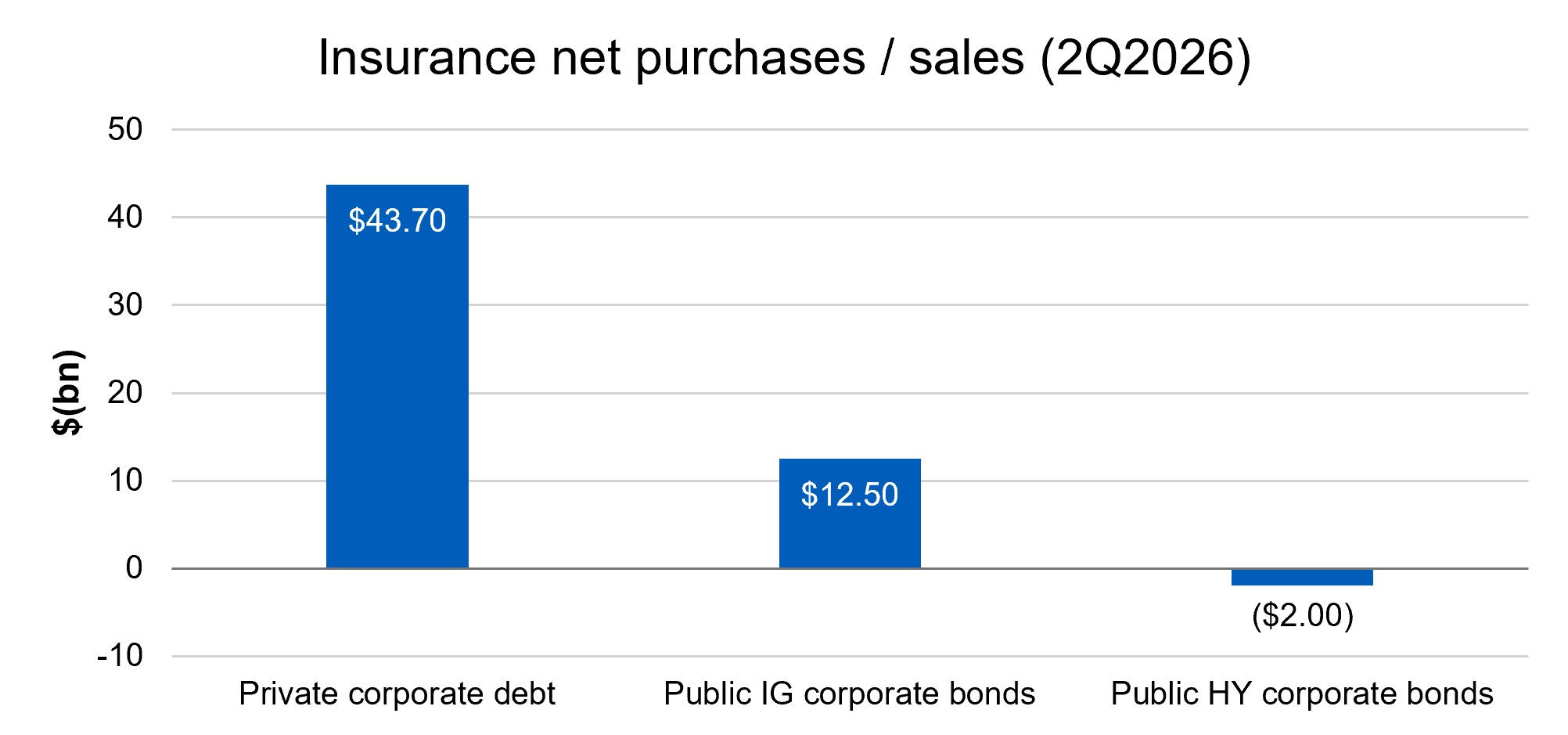
Source: Bank of America. Data as of September 25, 2026.
Why the search is broadening
To be sure, public IG bonds remain central to insurance portfolios for their scale, transparency, liquidity and well-established framework for liability matching. However, we continue to see broader utilization of securitized and private credit offerings as part of insurer fixed income portfolios relative to more traditional core fixed income and core “plus” mandates.
Primary drivers of the change are the potential for improved capital efficiency and an illiquidity premium that often enables insurers to improve their portfolio book yield while also increasing the overall credit quality of the portfolio, as measured by National Association of Insurance Commissioners (NAIC) classifications. Evidence of this transition can be found through increasing allocations in securitized and private credit, often at the expense of declining allocations in IG corporate bonds, sub-IG corporate bonds and emerging market debt (EMD).
- Approximately 87% of insurer securitized holdings are classified as NAIC 1, the highest NAIC credit quality rating, compared with approximately 56% of insurer corporate bond holdings.4
- Since 2020, insurer holdings of below-IG assets have declined from approximately 5.91% to 4.50% of fixed income holdings, as measured at year-end 2025.5
- US insurers’ EMD holdings declined from $46.9 billion at year-end 2019 to $31.7 billion at year-end 2024, even as total insurer bond portfolios increased from approximately $4.5 trillion to $5.4 trillion over the period.4
- Privately placed bonds represented 48.4% of total life-industry bonds at year-end 2025, up from 37.4% at year-end 2020.4
Borrowers today have more financing options. Complex financings that once might have reached public bond markets during difficult conditions can now be executed privately. Opportunities to negotiate protections or earn additional spread may therefore be shifting with them. IG private credit offers borrowers a route for transactions requiring confidentiality, tailored maturities, structural flexibility or more intensive lender engagement. For insurers, IG private credit has become an increasingly utilized tool when risk-adjusted spread provides sufficient compensation for any increased complexity and/or illiquidity.
The mix of incremental buying also suggests that insurers are increasingly willing to use different financing channels for different portfolio objectives. IG private credit can provide access to issuers, projects and maturities unavailable in public markets, while securitized assets offer diversified pools of contractual cash flows across structures, seniorities and collateral types.
The challenge for insurers
The migration toward private and securitized credit does not create automatic sources of excess return. Both require specialist underwriting of structure, documentation, downside risk and any illiquidity.
For example, the underwriting focus differs by market. In IG private credit, investors may negotiate covenants, reporting requirements and maturity profiles. In securitized credit, they assess collateral, structural protections and cash-flow waterfalls rather than relying solely on a corporate issuer’s creditworthiness. In either case, an investment must also fit the insurer’s broader balance-sheet needs.
For insurers deploying capital across public, private and securitized credit markets, a common framework can help compare compensation for risk, complexity and illiquidity. The task is to match available capital to specific requirements for yield, duration, liquidity, regulatory treatment and downside resilience. A broader set of investment channels can help meet those requirements without forcing capital into whichever public-market opportunities happen to be available.
A higher bar for active management
A broader opportunity set raises the bar for active managers. Managers need to compare public, private and securitized opportunities within a consistent framework, assessing spread alongside credit risk, structure, liquidity and capital treatment. The underwriting emphasis will differ across markets, as will the scope for trading and portfolio adjustment. Expected holding periods and stressed liquidity should therefore be explicit parts of the investment decision rather than assumed uniformly across asset classes.
For insurers, a broader opportunity set is valuable only if it improves the fit between assets and liabilities, improves capital efficiency and improves overall portfolio yield. The goal is not to replace public credit, but to selectively combine it with underwritten private and securitized exposures where they can offer better value for the risk, liquidity and capital required.
Notes
-
Source: S&P Global Ratings, “Insurers’ Capital Positions Set the Stage for Ongoing Resilience,” June 8, 2026.
-
Source: BofA Global Research, “2026Q2 Insurance Investment Activity,” 2026.
-
Source: L&G – Asset Management, America, “The capital logic behind US insurers’ growing securitized allocations,” May 6, 2026; based on J.P. Morgan and S&P data.
-
Source: S&P Capital IQ Pro. Data as of October 27, 2026.
-
Source: National Association of Insurance Commissioners, U.S. Insurers’ Emerging Markets Investments as of Year-End 2019, 2020; Decline in U.S. Insurers’ Emerging Markets Investments at Year-End 2024, 2025.
Disclosures
Unless otherwise stated, references herein to "L&G" and “L&G – Asset Management” refer to the global asset management business of Legal & General Group plc. that includes Legal & General Investment Management Ltd. (a U.K. FCA authorized adviser), Legal & General Investment Management America, Inc. (a U.S. SEC registered investment adviser) Legal & General Investment Management Asia Limited (a Hong Kong SFC registered adviser), Legal & General Investment Management Japan KK (licensed by the FAS in Japan), and LGIM Singapore Pte. Ltd. (licensed by the MAS in Singapore). The LGIM Stewardship Team acts on behalf of all such locally authorized entities.
This material is intended to provide only general educational information and market commentary. Views and opinions expressed herein are as of the date set forth above and may change based on market and other conditions. The material may not be reproduced or distributed. The material is for informational purposes only and is not intended as a solicitation to buy or sell any securities or other financial instrument or to provide any investment advice or service. L&G – Asset Management, America does not guarantee the timeliness, sequence, accuracy or completeness of information included. Past performance should not be taken as an indication or guarantee of future performance and no representation, express or implied, is made regarding future performance.
Certain of the information contained herein represents or is based on forward-looking statements or information, including descriptions of anticipated market changes and expectations of future activity. Forward-looking statements and information are inherently uncertain and actual events or results may differ from those projected. Therefore, undue reliance should not be placed on such forward-looking statements and information. There is no guarantee that L&G – Asset Management, America’s investment or risk management processes will be successful.
We have more blogs to share
Visit our blog site to explore our latest views on markets, investment strategy and long-term themes.